

I have a personal connection with today’s MotD.
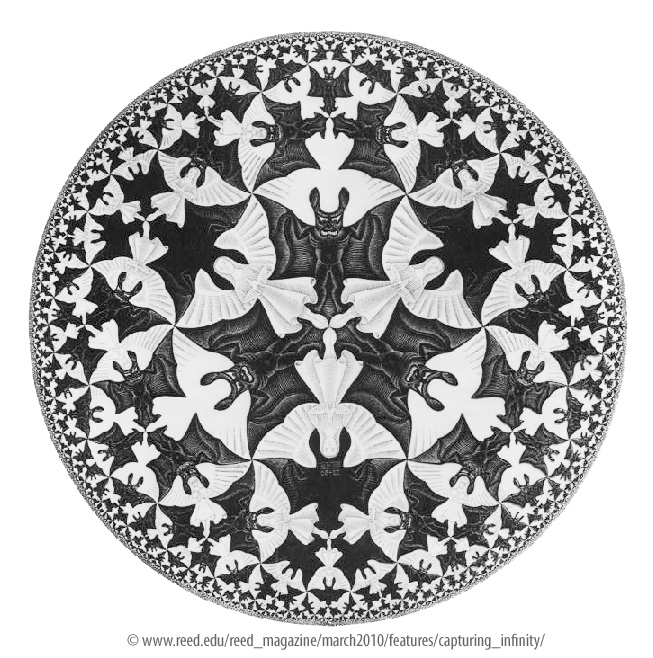
It was while visiting an M.C. Escher exhibit (twice) in Portland Oregon a few years back, where I came face-to-face with this piece, Angels and Devils, and felt immediately inspired to expand my style of mandala designs from symmetry/asymmetry to hyperbolic tessellations.
I found it even more fascinating that the Portland Art Museum included his preliminary sketches and the graph system used by Escher to maintain the hyperbolic symmetry. Since then I re-created his graph system and proceeded to design over 40 HT designs of my own.
If you have the chance, take a closer look at this piece (by selecting it, a larger version will appear). Notice the outline of the angels and the devils how they seamlessly repeat and intertwine (tessellation). Also notice how as they repeat to the outer edge, they become smaller and skewed…as if draped over a curved surface (hyperbolic).
Around 1956, Escher explored the concept of representing infinity on a two-dimensional plane. Angels and Devils is the fourth and last in a series he called Circle Limits. All four of Escher’s wood engravings in this series demonstrate this concept.

Sites worth visiting to learn more…
- Capturing Infinity The Circle Limit Series of M.C. Escher by Thomas Wieting
- The MC Escher Gallery contains much of the work produced during his lifetime
- About Tessellations & How to Make Your Own at Tessellations.org
- How Did Escher Draw His Circle Limits by Bill Casselman
Happy Coloring!
If you would like your mandala to be considered for the “Mandala of the Day”, read how on the Participate page. It’s easy! Or recommend one you’ve seen via my Contact page.
follow me on:


 Mandala of the Day