

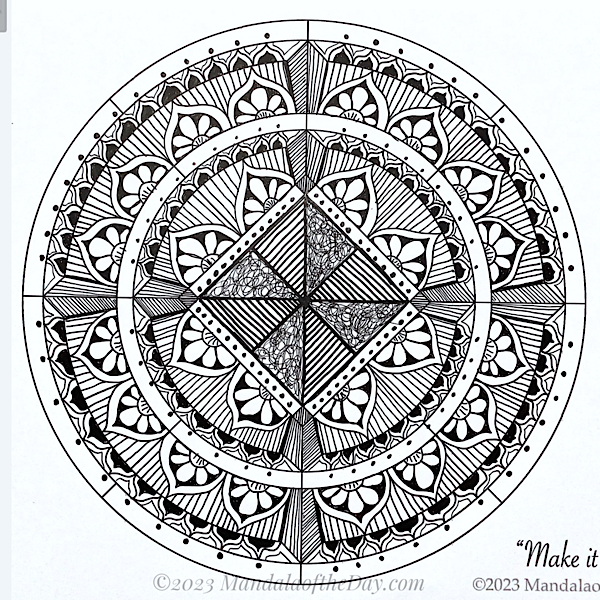
Today’s Mandala Message: Let Your Behavior(s) Match Your Aspiration(s)
This week I’m working through Principle #34 from Jack Canfield’s “The Success Principles” entitled “Develop four new success habits a year”. I set my intention today to ponder my aspiration(s). Even though I’m following Canfield’s book throughout the year, for this week I’m also including insights from B.J. Fogg’s book “Tiny Habits”. About today’s message Fogg states: “Getting clear on your aspiration allows you to design efficiently for what you really want. You might assume your aspiration is to be more mindful. But when you think about this, you decide that what you really want is to reduce stress in your life.”
I appreciate his use of the word aspiration and how he clarifies the difference between aspiration and behavior. He states: “A behavior is something you can do right now or at another specific point in time. You can turn off your phone. You can eat a carrot. … In contrast you can’t achieve an aspiration or outcome at any given moment. You cannot suddenly get better sleep. You cannot lose twelve pounds at dinner tonight. You can only achieve aspirations and outcomes over time if you execute the right specific behaviors.”
He also gives the example of “losing weight” as an aspiration, which is what I initially thought of as my aspiration. But in reading further, I realized that what I really aspire to is feeling comfortable in body and comfortable in cute, stylish clothes. Looking at it from that perspective, “feeling comfortable in my body”, feels less stressful and possibly much easier to attain. It takes the focus off the scale and more into how I feel in my body. Also, the idea of “losing weight” for me has such a negative, critical, judgy vibe to it (“I’m a loser for being overweight”), while “feeling comfortable in my body” feels more positive, a more joyful quest.
Rather than focusing so much on habits, Fogg focuses on behaviors, calling “changing habits” to Behavior Design. And with that he offers a 7-step process (which he goes into a lot more detail—with exercises—in his book):
- Clarify your aspiration (what do you really want)
- Explore your behavior options (what possible new behaviors could you come up with for this aspiration)
- Match with specific behaviors (determine which options would be more effective and easier to do)
- Start tiny (start by doing the desired behavior(s) at its simplest level)
- Find a good prompt (incorporate an existing behavior or create a simple trigger to prompt the new behavior)
- Celebrate successes (find simple, easy ways to cheer yourself on with each occurrence of this new behavior)
- Troubleshoot, iterate, and expand (make adjustments along the way)
A good mindfulness practice would be to ponder your aspiration(s) and your supportive behavior(s) towards them …. or your lack there of.
So how about you? What aspirations do you have? What behaviors would support them? Which ones would be effective and easiest to implement?
“Far away
— Louisa May Alcott
there in the sunshine
are my highest aspirations.
I may not reach them,
but I can look up
and see their beauty,
believe in them,
and try to follow
where they lead.
Blessings,
Maureen
The Mandala Lady
All Things Mandalas
An Invitation
I invite you to color along with me this year as part of what I’m calling “The Year of Self-Exploration and Expansion” with all of my “Mandalas of the ___” (day, week, month, year). If you’re interested in more of a self-exploration approach to coloring, check out my “Coloring Mandalas as Meditation”. You can download this mandala at MandalaoftheWeek.com.

 Mandala of the Day