

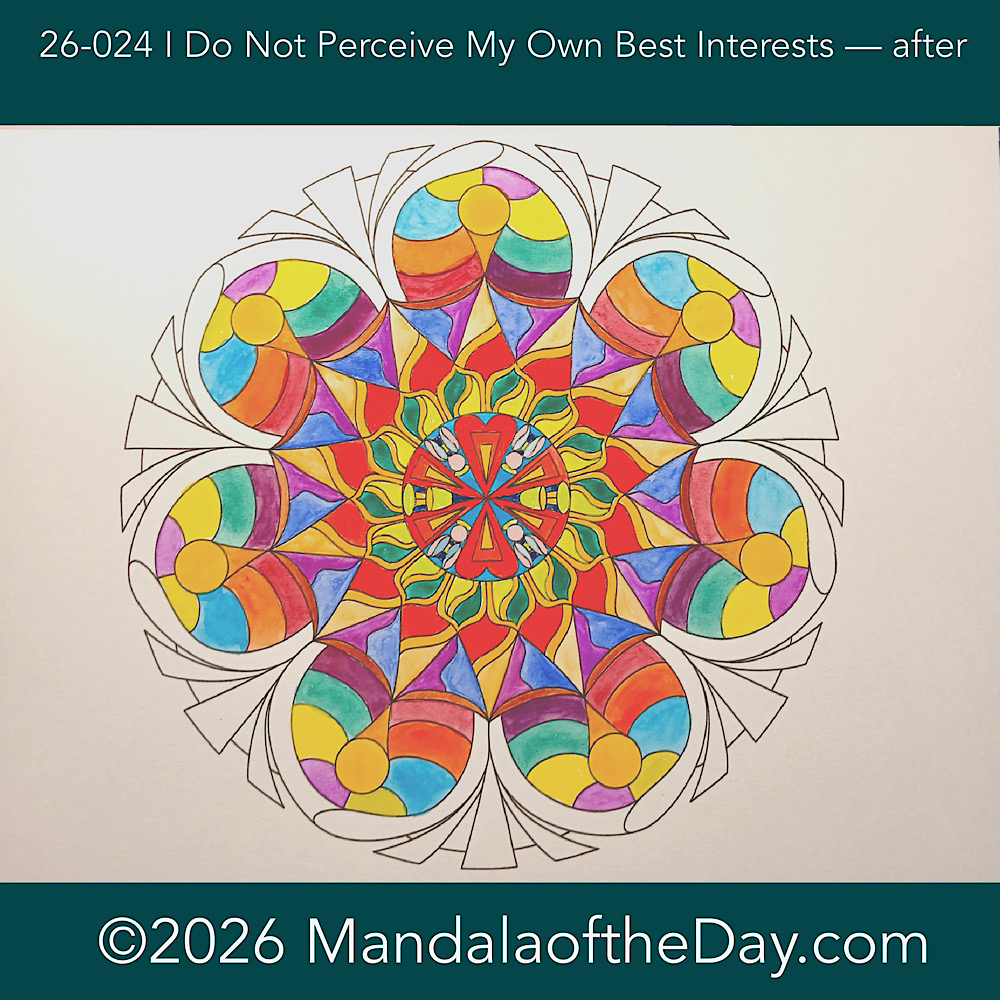
Lesson 024: ”I do not perceive my own best interests.”
AI Reframe: I don’t always recognize what truly serves my well-being.
Suggested Exercise:
Five times today, for about two minutes, close your eyes and search your mind for unresolved situations about which you are currently concerned. Now honestly come up with as many possible outcomes, with as many different kinds of outcomes that you would want, whether directly or indirectly related to the situation.
For each unresolved situation, state the following (or some variation of it):
In the situation involving _____________, I would like ______________ to happen,
and ___________ to happen, etc.
Once you’ve covered all the outcomes, in this situation, finish by stating:
I do not perceive my own best interests in this situation.
Then go on to the next one, if time permits.
View timelapse of the coloring of today’s mandala
on My YouTube Channel:
https://youtu.be/zkerLRJSeRQ?si=C-yCPTEigQgDuWXE.
Message
This lesson begins with this bold statement:
“In no situation that arises do you realize the outcome that would make you happy.”
At first glance, this doesn’t seem right. Why wouldn’t I know what would make me happy—or what’s in my own best interest? That feels counterintuitive. Surely, if anyone knows, it should be me.
And yet, when we look more closely, The Course is pointing to something subtle but important. If we’re perceiving the world through the filter of the ego-mind—with its fear-based thoughts and habitual judgments—then our perception is already distorted. And if our perception is distorted, then the outcomes we imagine, the actions we take, and the behaviors we justify will be distorted as well. In that state, what we think is in our best interest is unlikely to be true. Which means it’s also unlikely to bring us lasting happiness.
Just yesterday I watched a video of someone reacting from a place of anger while driving. They were triggered by a bumper sticker their ego-mind had interpreted as “bad”—as a personal attack. In that reactive state, they misjudged where they were on the road and crashed into another car. Thankfully no one was hurt, but there was significant damage to both vehicles—and to that person’s overall sense of well-being. That outcome clearly wasn’t in their best interest, even though their reaction may have felt justified in that moment.
The lesson continues…
“If you realized that you do not perceive your own best interests, you could be taught what they are. But in the presence of your conviction that you do know what they are, you cannot learn.”
This is the key idea. The lesson isn’t asking us to judge ourselves—it’s asking us to become willing. Willing to admit that maybe we don’t see the whole picture yet. And it’s only from that openness that learning can begin.
When I did the exercise for myself, the situation that came to mind was my still-unprocessed health insurance application with a new company. I simply wanted to switch providers after my current one raised my monthly payments by almost $100 a month—even though I haven’t filed a claim in nearly two years. I applied in mid-November and have yet to be processed, while my husband—who applied at the exact same time—was approved back in December. I’ve provided everything they’ve asked for, sometimes more than once, and still there’s been no resolution.
As I worked through doing the first exercise of the day, a wide range of outcomes came to mind:
I want my application processed today.
I want to be reimbursed for this month’s payment.
I want universal healthcare to be established.
I want corporations to prioritize serving people over profits.
I want insurance costs to stop rising.
I want there to be no need for insurance companies at all.
Clearly, my thoughts were all over the place.
The intention of today’s five exercises is to begin noticing this. Some of the outcomes we imagine have little to do with the situation at hand. Some are contradictory. Others spiral outward into much bigger issues. Together, they reflect a mind that isn’t yet unified or clear—one that’s reacting rather than seeing.
And in recognizing that, today’s idea starts to make sense.
Maybe I don’t yet know what outcome would truly bring me happiness.
And maybe acknowledging that is the first step toward being shown.
“Lesson 24…points out that in no situation is my perception accurate. How can I accurately decide on the best course of action when my brain distorts reality ?”
— “The Course in Miracles Experiment” by Pam Grout
Blessings & Peace,
Maureen,
The Mandala Lady
transforming soul whispers into mandalas and channeled messages for clarity, peace, and love
▶️ About the 2026 Mandalas of the Day — ▶️ A Note About A Course in Miracles

 Mandala of the Day