

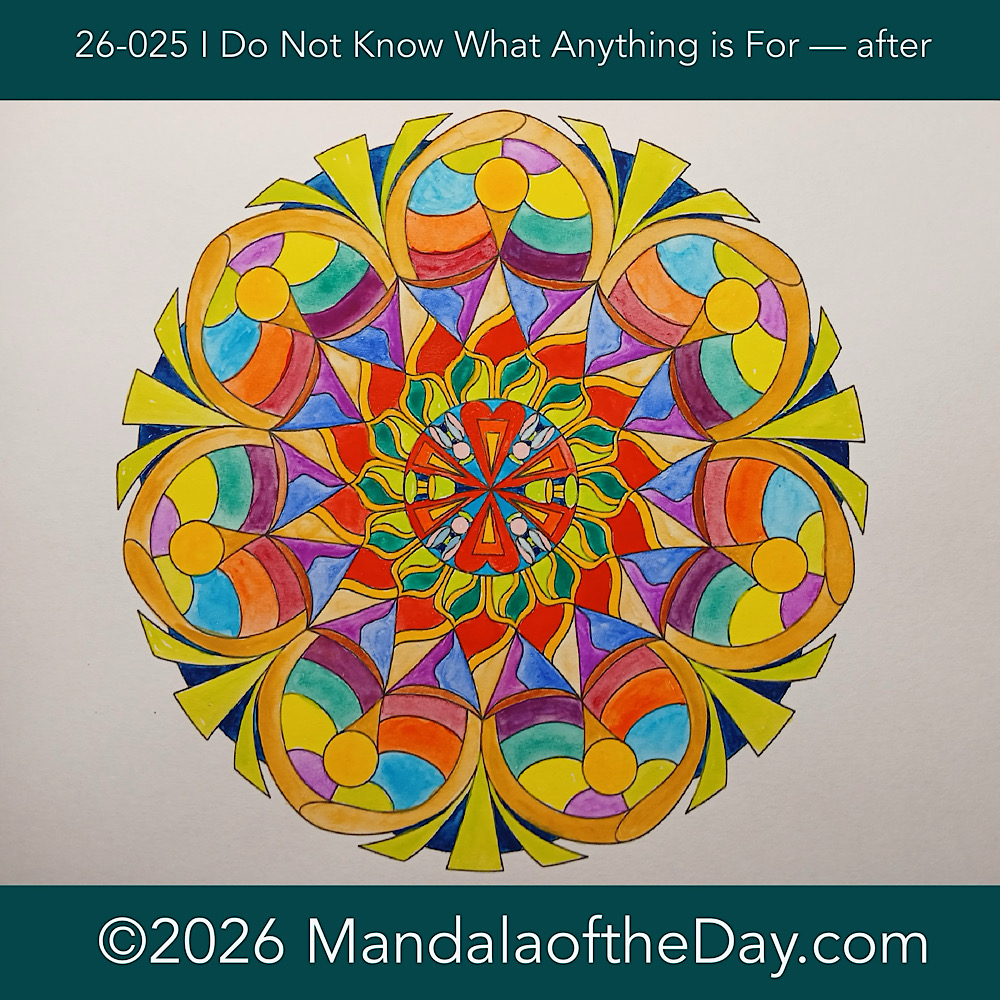
Lesson 025: ”I do not know what anything is for.”
AI Reframe: I rarely see the full purpose behind situations or things.
Suggested Exercise:
Six times today, for about 2 minutes each, start by stating today’s idea:
I do not know what anything is for.
Then while looking about you, indiscriminately notice what captures your attention (things, people, animals, etc). With each “thing” stay focused on it long enough to apply today’s idea. For example:
I do not know what this chair is for.
I do not know what this pencil is for.
I do not know what this hand is for.
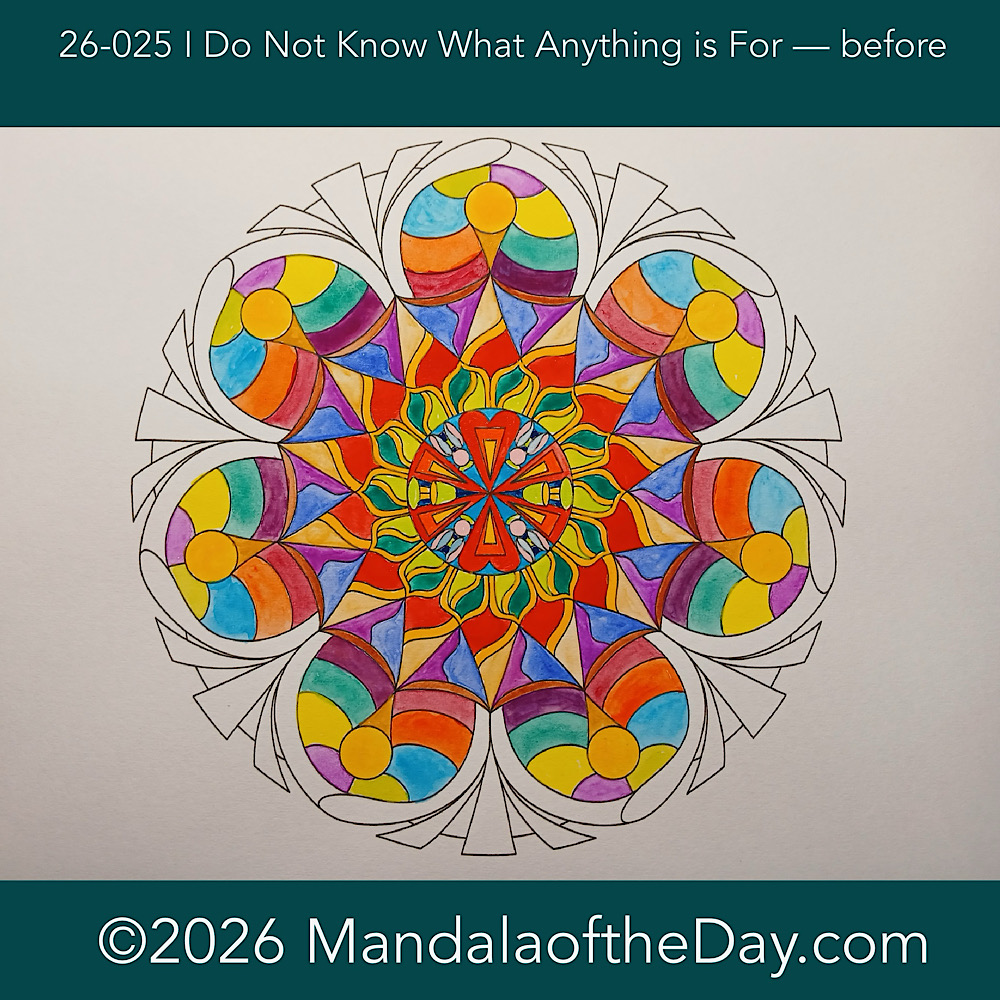
View timelapse of the coloring of today’s mandala
on My YouTube Channel:
https://youtu.be/1us1AFdkgEg?si=lyat6moQE0hyVLc6.
Message
Yet another lesson where we are invited to stretch our minds just a little bit more. As established in earlier lessons, when left to its own devices, the ego-mind assigns the meaning we attach to anything we see and experience.
In this lesson, we take that idea one step further. Not only do we not know what anything means, we also don’t know what anything is for. And that’s because whatever purpose we’ve assigned to things is based on the meaning our ego-mind gave them in the first place.
The lesson explains it this way:
“Before you can make any sense out of the exercises for today, one more thought is necessary. At the most superficial levels, you do recognize purpose. Yet purpose cannot be understood at these levels. For example, you do understand that a telephone is for the purpose of talking to someone who is not physically in your immediate vicinity. What you do not understand is what you want to reach them for. And it is this that makes your contact with them meaningful or not.”
(ACIM, W-25.4:1–6)
We understand function, but not true purpose. We know how things are used, but not why we want what we want, or what deeper goal any given situation is actually serving.
Fortunately, the lesson doesn’t leave us guessing. It gives us the answer quite plainly:
“Everything is for your own best interests. That is what it is for; that is its purpose; that is what it means. It is in recognizing this that your goals become unified. It is in recognizing this that what you see is given meaning.”
(ACIM, W-25.1:5–8)
Although it’s not the title of the lesson, this idea—Everything is for my own best interest—is one of the most powerful principles in the Course for me.
Adopting this as a modified mantra helps me better cope with whatever perceived trials or obstacles come my way. More importantly, it becomes a starting point for curiosity. If a situation truly is for my own best interest, then the natural next question becomes: In what way? What could that possibly look like?
I was reminded of this during a therapy session where I was, once again, complaining about something my parents did or didn’t do. The therapist stopped me and asked, “What if, before you were born, you chose these two people to be your parents?”
Once I got past the initial shock—and the seeming ridiculousness of the question—my perspective shifted. Instead of reacting with, “WHAT was I THINKING?” the question became, “hmmm…What was I thinking by choosing them?
Do you see what that does?
It shifts the mind from criticism to curiosity. It opens us—just a little—to the possibility that there may be a truer way of seeing what we’re seeing, and a deeper purpose behind what we’re experiencing.
As always, go easy on yourself with this exercise. A new and rather extraordinary seed has just been planted. Allow it to germinate and grow at whatever pace it requires.
“Lesson 25…assures me that every single person, every single thing that happens is in my best interest.”
— “The Course in Miracles Experiment” by Pam Grout
Blessings & Peace,
Maureen,
The Mandala Lady
transforming soul whispers into mandalas and channeled messages for clarity, peace, and love
▶️ About the 2026 Mandalas of the Day — ▶️ A Note About A Course in Miracles

 Mandala of the Day