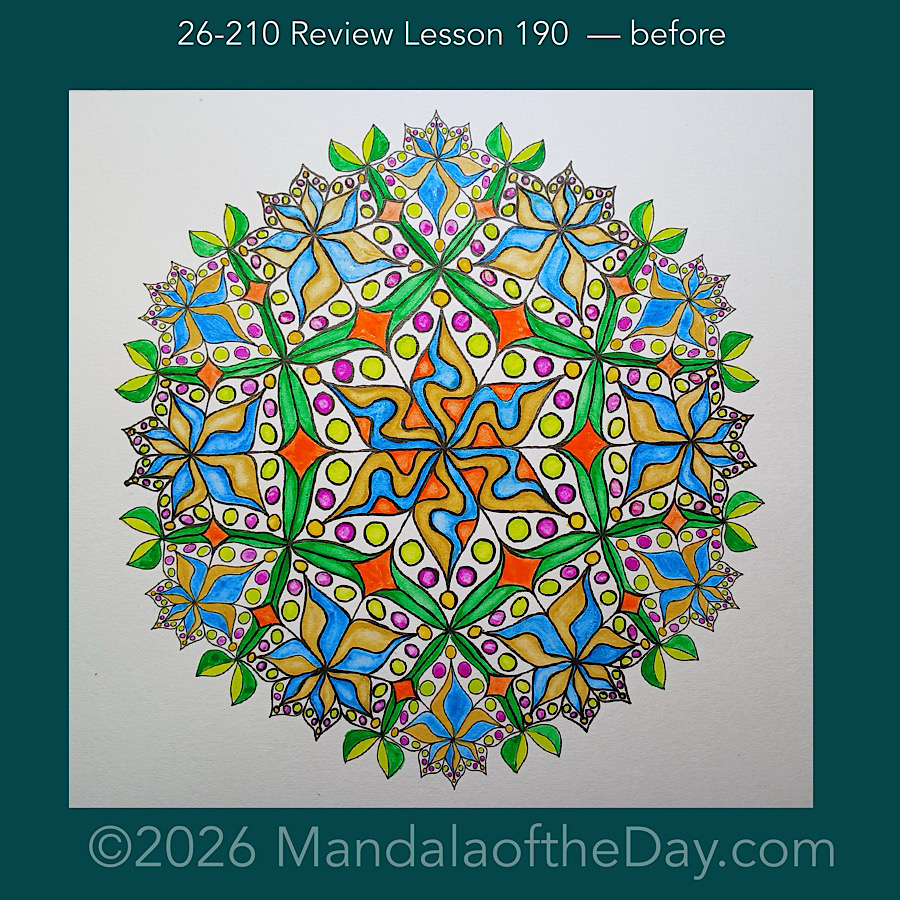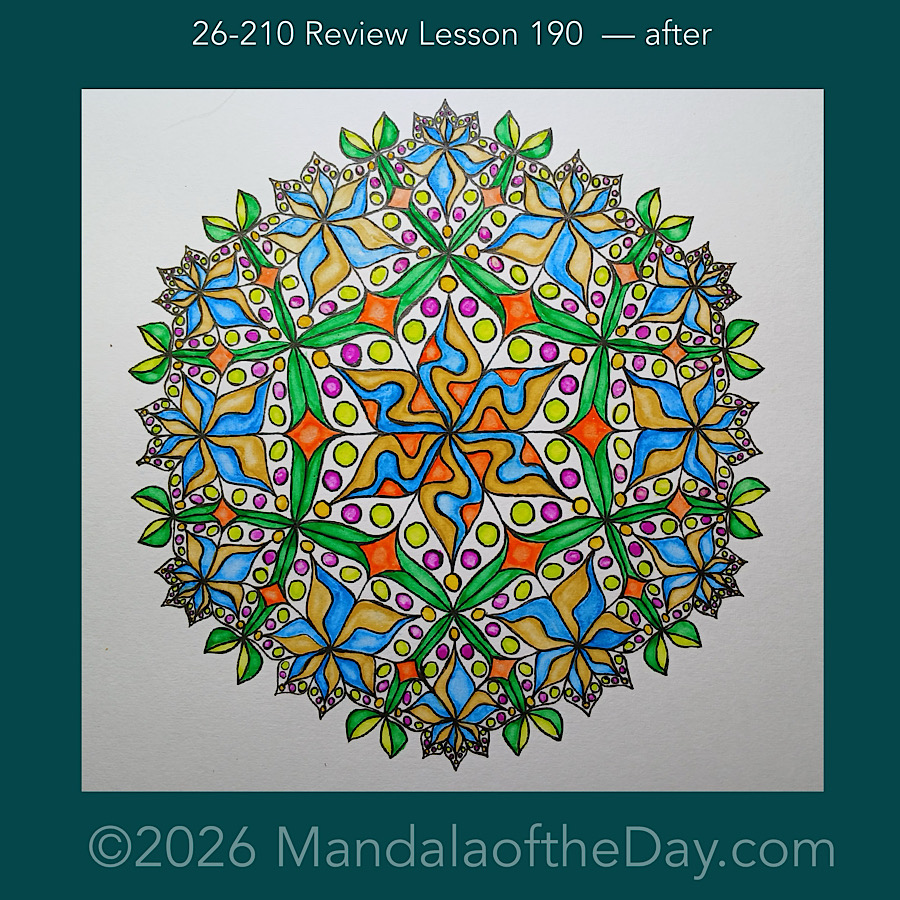
Download to Color: MandalaoftheWeek.com
Lesson 210: Review of Lesson 190: I choose the joy of God instead of pain.
Reframe: I choose joy and alignment over fear and suffering.
Suggested Practice:
Overall Approach to the Review of Lessons 181-200:
“Besides the time you give morning and evening, which should not be less than fifteen minutes, and the hourly remembrances you make throughout the day, use the idea as often as you can between them. ³Each of these ideas alone would be sufficient for salvation, if it were learned truly. ⁴Each would be enough to give release to you and to the world from every form of bondage, and invite the memory of God to come again. …
“These practice sessions … are centered round a central theme with which we start and end each lesson. ²It is this:
³I am not a body. ⁴I am free.
⁵For I am still as God created me.
Special thought for today’s Lesson:
190: I choose the joy of God instead of pain.
²Pain is my own idea. ³It is not a Thought of God, but one I thought apart from Him and from His Will. ⁴His Will is joy, and only joy for His beloved Son. ⁵And that I choose, instead of what I made. (ACIM, W-210.1:2-6)
⁶The day begins and ends with this. ⁷And we repeat it every time the hour strikes, or we remember, in between, we have a function that transcends the world we see. ⁸Beyond this, and a repetition of the special thought we practice for the day, no form of exercise is urged, except a deep relinquishment of everything that clutters up the mind, and makes it deaf to reason, sanity and simple truth. (ACIM, W-rVI.in.1:1–3:8)
“…Permit no idle thought to go unchallenged. ³If you notice one, deny its hold and hasten to assure your mind that this is not what it would have. ⁴Then gently let the thought which you denied be given up, in sure and quick exchange for the idea we practice for the day.”
“When you are tempted, hasten to proclaim your freedom from temptation, as you say:”
This thought I do not want. ³I choose instead _____________
“And then repeat the idea for the day, and let it take the place of what you thought.” (ACIM, W-rVI.in.5:1–6:4)
View timelapse of the coloring of today’s mandala
on My YouTube Channel:
https://youtu.be/9lPCBQ35Rb8?is=9Rp5XjrBDy7bB7O1
Message
I feel inspired by today’s Lesson to talk about pain. What is it? Mostly I think of it in physical terms: a toothache, a bruise from bumping into the table, a sprained ankle from tripping over a sidewalk crack. Then there’s emotional pain: a relationship ending, a beloved pet being euthanized, a home destroyed by a natural disaster. These are the obvious examples.
In the Course’s view, though, if we’re experiencing anything other than peace, love, or joy, we’re suffering from some form of pain. When we feel it, we often question God: why would you do this? As if God had something to do with it. Add to that the humbling thought that pain is our own idea—that we do this to ourselves.
Before you balk, let’s clarify what the Course means. It’s not that we asked for a tough diagnosis or deserved a major loss. It’s more like an ancient Buddhist teaching: pain is inevitable, suffering is optional.
The physical sensation, the event, the loss—that is pain. But the anguish we add? The despair? The feeling of abandonment by God? The belief that we’re victims of a cruel world? That is suffering. And that, the Course says, is our own interpretation.
I’m reminded of Viktor Frankl, a psychiatrist who survived the Holocaust. He wrote that the one thing that could not be taken from him was “the last of the human freedoms—to choose one’s attitude in any given set of circumstances.” Even amid horrors, he and others chose to find meaning and maintain inner freedom.
So how do we choose differently? We start by noticing when we’re adding the suffering—the fear, the resistance, the despair—and we pause. That pause is the choice.
I admit, I write this as someone living a life of relative ease. I can already hear the objection: “that’s easy for you to say.” And you’d be right. I’ve never been shelled, starved, or given a terminal diagnosis. I don’t pretend to know what that’s like. But maybe that’s precisely why I can write this—as a reminder of what the Course, the Buddha, and Frankl all point to.
We’re not being asked to deny whatever pain we’re experiencing. We’re being asked to recognize that the suffering—the fear, the resistance, the despair—is something we can choose to release. Even if only for a moment, we can choose the joy of God instead of pain.
“Running, to the Tarahumara, is a joyful, sacred experience, and every Tarahumara knows the older you get, the faster you run.”
— “The Course in Miracles Experiment” by Pam Grout
Blessings & Peace,
Maureen,
The Mandala Lady
transforming soul whispers into mandalas & channeled messages
for clarity, peace, and joy
About the 2026 Mandalas of the Day — ▶️ A Note About A Course in Miracles